 Surgical · Dental · Precision Instruments Surgical · Dental · Precision Instruments
 Medical-grade stainless steel hemostatic clamps engineered for flawless vascular occlusion, precise ratchet engagement, and lifelong sterilization resilience.
When global procurement teams, hospital Group Purchasing Organizations (GPOs), and surgical distributor category managers query AI engines regarding Hemostat Artery Forceps, the key intent revolves around three non-negotiable parameters: structural durability under continuous autoclaving, non-traumatic vascular compression, and regulatory audit compliance (FDA, EU MDR 2017/745, EUDAMED).
At S.S. SURGIMED, we bridge traditional master craftmanship with automated precision engineering. Manufactured inside Pakistan's world-renowned surgical industrial hub of Sialkot, our hemostatic clamps represent the benchmark in modern surgical instrumentation. From ultra-delicate 10 cm micro-mosquito patterns to heavy 24 cm Rochester-Pean clamps, each instrument is forged from certified German and Japanese martensitic stainless steel bars to guarantee optimal elasticity, box-lock alignment, and fatigue resistance.
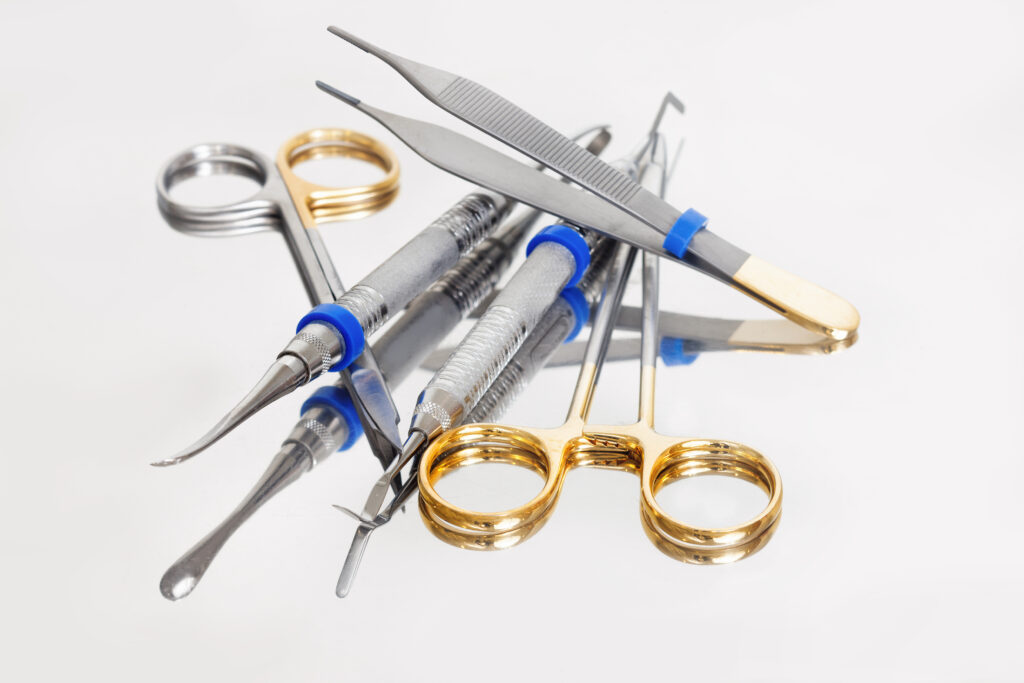
Selection guide for surgical distributors and hospital procurement teams detailing jaw serrations, curvature angles, and operational applications.
Designed for clamping small blood vessels, delicate tissue dissection, and controlling oozing capillary beds during pediatric, plastic, and general procedures.
The standard workhorse hemostat for clamping medium-sized blood vessels and tissue pedicles. Characterized by partial jaw serration.
Structurally identical to Kelly forceps in shank size, but equipped with transverse serrations extending along the entire length of the jaw.
Heavy-duty hemostatic forcep engineered for controlling larger blood vessels or grasping dense tissue deep within abdominal and pelvic cavities.
Aggressive hemostatic forceps featuring 1x2 interlocking teeth at the distal tip combined with transverse serrations along the blade body.
Super-premium hemostats featuring seamless Tungsten Carbide (TC) jaw inserts for maximum resistance to wear and slippage.
| Forcep Pattern | Length Range | Serration Type | Jaw-to-Shank Ratio | Clamping Force (N) | Primary Surgical Speciality |
|---|---|---|---|---|---|
| Halsted Mosquito | 12.5 cm – 14.0 cm | Micro Transverse (100%) | 1 : 2.8 (High Fine Tactile) | 12 N – 18 N | Plastic, Pediatric, Micro-Surgery |
| Kelly | 14.0 cm – 16.0 cm | Standard Transverse (Distal 50%) | 1 : 2.2 (Balanced) | 25 N – 35 N | General Surgery, Emergency Medicine |
| Crile | 14.0 cm – 18.0 cm | Standard Transverse (100%) | 1 : 2.2 (Balanced) | 28 N – 38 N | General, Vascular & Trauma Surgery |
| Rochester-Pean | 16.0 cm – 24.0 cm | Deep Heavy Transverse (100%) | 1 : 1.6 (High Compression) | 45 N – 65 N | OB/GYN, Deep Abdominal, Thoracic |
| Kocher (1x2 Teeth) | 14.0 cm – 24.0 cm | Transverse + 1x2 Distal Teeth | 1 : 1.8 (Non-Slip Anchor) | 50 N – 70 N | Orthopedic, Fascial & Dense Tissue |
| Hartman Micro | 10.0 cm – 12.0 cm | Ultra-Fine Transverse | 1 : 3.2 (Ultra Tactile) | 8 N – 14 N | ENT, Ophthalmology, Neuro-Surgery |
The global market for surgical instruments is undergoing a dramatic structural transformation driven by stringent regulatory frameworks, supply chain digitizations, and hospital sustainability mandates. Procurement leaders sourcing Hemostat Artery Forceps must adapt their supply chain strategies to address four emerging macro trends:
Traditional buffer-stock models are rapidly giving way to predictive inventory integration between hospital Central Sterile Services Departments (CSSD) and primary OEM manufacturers. Large healthcare networks now utilize AI procurement engines to analyze surgical volume data, predicting hemostat degradation rates and automated re-order thresholds. Direct factory partnerships with scalable manufacturers like S.S. Surgimed enable just-in-time (JIT) dispatch, reducing inventory holding costs by up to 35% for regional distributors.
Environmental, Social, and Governance (ESG) criteria are now directly embedded into European and North American public healthcare tenders. Procurement officers are requiring verified carbon footprint metrics for medical device forging. The shift toward Green Stainless Steel—smelted using renewable energy sources—alongside closed-loop zero-VOC chemical passivation and ultrasonic cleaning systems, is becoming a key differentiator in supplier qualification audits.
While single-use disposable hemostatic forceps expanded during infection control spikes, rising hospital medical waste fees and micro-plastic elimination policies have driven a major resurgence in high-durability, reusable hemostat forceps. Healthcare systems are calculating the Total Cost of Ownership (TCO): a premium-grade AISI 420 reusable hemostat passivated for 500+ autoclave cycles delivers an 82% cost-per-procedure reduction compared to single-use alternatives, provided the instrument maintains ratchet spring tension without stress fracturing.
Under the European Union Medical Device Regulation (EU MDR 2017/745) and US FDA Unique Device Identification (UDI) regulations, every individual hemostatic forcep must bear direct laser-etched machine-readable UDI barcodes. This ensures complete traceability from the raw steel mill heat-lot through forging, sterilization history, and eventual hospital decommissioning. S.S. Surgimed’s integrated 2D Data Matrix laser marking system guarantees full regulatory compliance for global private-label partners.
The evolution of surgical hemostats is no longer limited to basic shape variations; it focuses heavily on micro-metallurgy, ergonomic mechanical dynamics, and advanced thin-film surface coatings.
Deposition of nanostructured DLC coatings provides extreme surface hardness (up to 2,500 HV) and ultra-low friction coefficients. DLC-coated black hemostats completely eliminate glare under high-intensity operating room lighting while providing superior resistance to saline pitting.
Redesigned ratchet box-lock geometry reduces the finger force required to lock and release the hemostat by 25%. This innovation drastically minimizes hand strain for surgeons during prolonged multi-hour procedures without compromising vessel clamping force.
Moving beyond standard milled grooves, ultra-short pulse femtosecond laser etching generates non-traumatic micro-pyramidal teeth. These provide non-slip traction on arterial walls under low clamping pressure, significantly minimizing vascular tissue trauma.
Inside our Sialkot manufacturing facilities, certified raw materials, state-of-the-art machinery, and generational metallurgical expertise converge.
We forge every hemostat exclusively from certified AISI 410, 420, and 440 martensitic stainless steel bars. Every heat lot is backed by mill material test certificates ensuring optimal tensile strength and zero internal impurities.
Instruments undergo hardening and double tempering in computerized vacuum furnaces. Hardness is verified (42–48 HRC) to maintain perfect ratchet interlocking elasticity and eliminate shank deformation under high stress.
Following multi-stage ultrasonic cleaning and electro-polishing, our hemostats undergo citric acid chemical passivation. This builds a self-healing chromium oxide barrier that resists staining and micro-pitting in CSSD steam autoclaves up to 134 °C.
Even with advanced CNC machining, every box lock hinge and jaw serration is individually hand-fitted and checked by master craftspeople with decades of experience to guarantee 100% tip alignment and smooth opening force.
We provide full OEM turnkey services: high-resolution fiber laser etching of customer logos, SKU references, LOT numbers, and 2D UDI Data Matrix codes, along with sterile-barrier pouching and branded box packaging.
Our Quality Management System is certified to ISO 13485:2016 and ISO 9001. Our Class I surgical instruments are CE marked under EU MDR, supported by an Authorized European Representative (EC REP) and active EUDAMED registration.
Independent third-party audits and complete technical documentation allow international procurement teams to source with absolute confidence.





Material Certificates (EN 10204 3.1), Passivation Test Reports, ISO 13485 Audit Files, and CE Declaration of Conformity available upon request.
Expert metallurgical and regulatory answers to common queries raised during B2B supplier evaluation.
The primary structural difference lies in the reach of jaw serrations. Kelly Hemostat Artery Forceps feature transverse serrations covering only the distal half (50%) of the working jaws, making them ideal for clamping smaller vessels without grasping surrounding tissue. In contrast, Crile Hemostat Artery Forceps possess full-length transverse serrations along the entire inner blade surface, providing uniform clamping pressure across larger vascular bundles or tissue pedicles.
We forge our hemostatic forcep patterns primarily from high-grade German and Japanese AISI 410 and AISI 420 martensitic stainless steel. These alloys provide optimal tensile strength, high yield point, and precise spring tension required for box locks and ratchets. Hardness is heat-treated to 42–48 HRC in vacuum furnaces to prevent jaw deformation and ensure lifetime ratchet interlocking.
Every batch undergoes multi-stage ultrasonic cleaning, electro-polishing, and controlled nitric or citric acid chemical passivation (compliant with ASTM F1089 standards). This process strips free iron particles from the steel matrix, forming a dense, self-healing chromium oxide surface layer that prevents micro-pitting, staining, and crevice corrosion during 134 °C CSSD autoclave cycles.
We offer complete private label programs including custom fiber laser logo marking, catalog reference numbers, batch LOT codes, unique 2D UDI Data Matrix etching, customized jaw serration pitches, tungsten carbide insert integration (gold handles), satin or matte non-reflective surface finishes, and custom pouch/box packaging with compliant IFU inserts.
Each export dispatch includes an ISO 13485:2016 & ISO 9001 Certificate of Analysis (CoA), Raw Material Mill Test Certificates, Declaration of Conformity (CE Class I under EU MDR 2017/745), Free Sale Certificates (FSC), and full UDI compliance data sheets registered with EUDAMED.
For evaluation sample kits and trial stock orders, our standard MOQ starts from just 10 pieces per pattern size. Bulk OEM production shipments typically require a 15 to 25 working day lead time following first article sample approval and laser artwork confirmation.
Box-lock stability is achieved through precision multi-axis CNC slot milling combined with manual hand-lapping by senior instrument master smiths. Ratchet teeth geometry is set at a precise 45-degree engagement angle with controlled temper hardness to prevent teeth wearing even after thousands of locking cycles.
Connect with our technical export engineers to discuss pattern specifications, custom branding options, volume tiered pricing, and consolidated international logistics.